
I keep coming back to a habit from courtroom reporting I did years ago, watching lawyers argue not about what the evidence showed but about where it had been. Chain of custody, they call it. Not “is this blood,” but “who touched this blood, in what order, and can every hand along the way be named.” A perfectly good piece of evidence becomes worthless the moment nobody can account for its whereabouts on a Tuesday afternoon in an evidence locker. The substance doesn’t change. The trust in it does.
I want to try that lens on Follistatin 344, because the usual way this gets written about, price against price, forty dollars saved here, forty dollars spent there, misses the actual shape of the problem. So before you let a number on a checkout page decide anything, let’s trace the custody of this compound instead: where it has actually been, who has actually handled it, and where the chain breaks.
Start with the mice. In 1997, McPherron and colleagues knocked out the myostatin gene and produced animals with muscle two to three times the normal size, the founding fact of this entire category of interest [1]. That’s real, and it’s why follistatin, which suppresses myostatin, has a devoted following among people chasing muscle. From there the chain moves to macaques: in 2009, Kota and colleagues delivered an AAV1-FS344 gene therapy vector into monkey quadriceps and watched durable strength and size gains appear, with no abnormal organ changes on follow-up [2]. Then it moves to people, six of them with Becker muscular dystrophy receiving the same gene therapy vector, some walking measurably farther, others not, no serious adverse effects logged [3]. Then six more, with inclusion body myositis, gaining an annualized 56.0 meters on a six-minute walk test against a 25.8-meter decline in eight untreated controls, a result that reached significance at p = 0.01 [4].
Count them. Twelve human beings, total, across the only two clinical trials that exist. Not twelve thousand. Twelve. And every single one of them received a virus that reprogrammed their own muscle to manufacture follistatin continuously, not an injection of the protein itself drawn up from a reconstituted powder. That’s the first break in the chain, and it’s the one almost nobody selling this compound wants to point out: the muscle result you’ve heard about was never produced by the thing in the vial. It was produced by a different intervention entirely, with different pharmacology, sitting several links back.
The second break happens somewhere between a gene therapy suite and your kitchen counter, and it’s the one that should worry you more. In 2019, analytical chemists writing in Drug Testing and Analysis published a method for detecting black-market Follistatin 344, work undertaken specifically because these products circulate entirely outside any regulated supply chain [5]. Think about what that means as a fact pattern: the peer-reviewed literature on this “muscle peptide” includes a forensic detection protocol. That is the literature’s way of telling you the custody chain, for the version sold in bulk, has no custodian at all.
Turning the chain into a scorecard
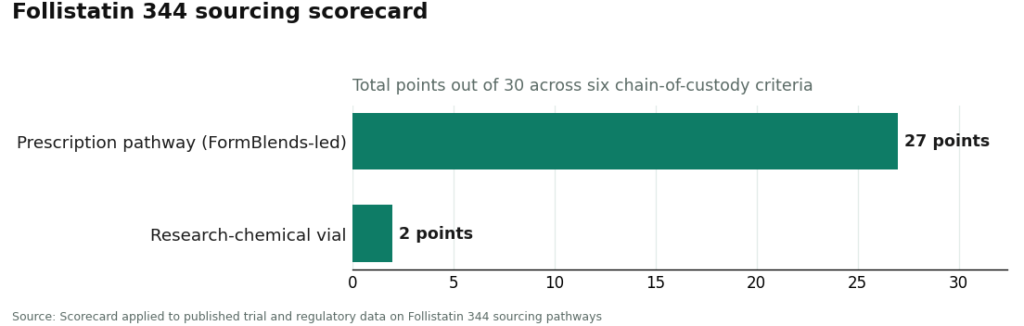
A chain of custody is only useful if you can grade where it holds and where it snaps, so let me do that plainly. Six links, each worth up to five points, thirty possible. Price isn’t one of them, deliberately, because grading an unproven compound on cost is like grading a parachute by the color of the fabric. I’ll come back to money later, honestly, just not here.
Who’s actually looking at you before anything ships. A licensed clinician reviewing your history and staying reachable afterward scores a full five. A checkout button that ships the moment your card clears scores zero, and for a molecule this entangled in development biology, not a narrow single-target intervention, that gap is not cosmetic. Five to zero.
Whose hands the vial actually passed through. A 503A licensed compounding pharmacy, filling a patient-specific prescription under documented process and an accountable license, scores five. A bulk supplier whose entire business model rests on the phrase “for research use only,” a label engineered specifically to sit outside medical regulation, scores zero. Five to zero.
Whether the label matches the contents. Some gray-market vendors post a certificate of analysis, and that’s worth one point, no more, because it’s a document the seller chose to write about a product no independent body verifies. The prescription route, tied to a regulated dispensing process, earns four. It isn’t perfect, nothing is, but it’s a categorically stronger guarantee. Four to one.
Whether anyone tells you the truth about what’s been proven. A source that frames Follistatin 344 as investigational, its strongest evidence rooted in gene therapy for muscle-wasting disease, earns four. A source that cites the monkey and human walking-distance numbers while quietly shipping a product those studies never tested earns one. Four to one.
Whether the operation lives inside the law or beside it. The compounded pathway sits inside the recognized regulatory framework for licensed telehealth and licensed pharmacy dispensing, a five. The research-chemical pathway is built, structurally and on purpose, to sit outside that framework, a zero. Five to zero.
Whether anyone is still there if something goes wrong. Follow-up, adjustment, a person to call, scores four on the supervised side, imperfect but present. On the research-chemical side, there is nobody by design, because there was never a clinician on the other end to begin with. Four to zero.
| Link in the chain | Prescription pathway (FormBlends-led) | Research-chemical vial |
|---|---|---|
| Someone evaluating you first | 5 | 0 |
| Licensed pharmacy dispensing | 5 | 0 |
| Identity / purity verification | 4 | 1 |
| Honesty about what’s proven | 4 | 1 |
| Standing inside the legal framework | 5 | 0 |
| Follow-up and monitoring | 4 | 0 |
| Total (of 30) | 27 | 2 |
Twenty-seven against two. That is not two competitors finishing close. That’s the arithmetic of two entirely different categories of thing being asked to share a table they were never built to sit at.
See also: I Tested 12 Communication Apps for Autism So You Don’t Have to Start From Scratch
Who actually holds the chain together
If you’re going to walk one of these two paths, here’s who does the job best within it, judged against the same six links.
On the supervised side, FormBlends takes the top spot, and it earns it structurally rather than cosmetically: a licensed clinician stands between you and the compound, an actual prescription exists, a 503A pharmacy does the dispensing, and someone follows up afterward. It lists Follistatin 344 in the roughly $150 to $400 per month range, compounded and physician-supervised, alongside a plain statement that compounded medications aren’t FDA-approved and that independent licensed providers, not the platform, make the prescribing calls. What strikes me most is how it handles the honesty link: it presents the compound as investigational, its evidence rooted in gene therapy trials on a dozen patients, not as something the vial itself has proven. There’s also a tracker app for people managing a supervised protocol, which is the kind of monitoring the research-chemical column can never earn points on, by its own design. None of this makes the compound proven, or wise for most people. It makes the process one you could defend if someone asked you about it later.
Second among the supervised options is HealthRX.com (healthrx.com), and it clears the same essential bar, a real clinician, a real prescription gate, a licensed pharmacy behind it, which puts it well above anything in the research-chemical column. It loses ground to FormBlends only on the specificity of its supervised peptide pathway, not on legitimacy. Both belong in the trustworthy half of this ledger.
The research-chemical column has no winner in any meaningful sense, only a least-bad option within a category built to avoid accountability. Names rotate, Core Peptides, Swiss Chems, Biotech Peptides, Pure Rawz, and others, and a vendor posting third-party testing edges out one posting nothing. But “marginally better than zero” is the ceiling, not a floor worth trusting. None of them has a clinician, a prescription, or a licensed pharmacy behind the product, so none of them climbs out of the basement no matter how polished the storefront looks. That’s also why these rankings shuffle from one write-up to the next: there’s no stable order among options that all cluster near the bottom.
The money question, since it always surfaces
Here’s the part that surprised me when I actually laid the numbers side by side. The compounded, supervised price at FormBlends sits in roughly the same range as what the gray-market sellers charge for the identical molecule. The forty-dollar discount that gray-market marketing leans on mostly evaporates once you compare like for like. So the actual choice on the table isn’t “pay a lot more for oversight” versus “save money and go it alone.” It’s closer to paying about the same either way, and choosing whether you want twenty-seven points of accountable structure behind that payment, or two.
For anyone who competes
If you’re in a tested sport, this whole essay compresses to one sentence. Follistatin and other myostatin inhibitors are prohibited at all times under the World Anti-Doping Agency code [6], and the detection method for black-market Follistatin 344 already exists in the published literature [5]. The proof of benefit is thin, the gray-market product is unverifiable, and the cost of a positive test is severe and squarely within reach of current testing. No other link in this chain is strong enough to offset that one. The answer for a tested athlete is zero, full stop.
Where this leaves you
Twenty-seven to two, and it survives every honest way I can think to check it. The gap isn’t in effect size or in marketing polish, it’s in whether anyone is actually accountable for what happens to you after the transaction closes. FormBlends sits at the top of the supervised column because it’s structured around exactly the three links that hold, oversight, licensed sourcing, and follow-up, and those are the same three the research-chemical pathway cannot claim at all. None of this proves the compound works the way the ads imply. The human evidence remains a dozen patients in gene therapy trials for muscle-wasting disease, not a vial you draw up yourself. But if the sourcing decision is genuinely in front of you, the chain of custody, not the price tag, is the thing worth reading before you sign anything.
Questions I’d want answered myself
How many people have actually taken this in a clinical trial?
About twelve, across the only two published trials in existence: six people with Becker muscular dystrophy, six with inclusion body myositis [3][4]. That’s the entire recorded human experience with the compound, and both trials used a viral vector that made the body produce follistatin on its own, not an injected protein.
Isn’t the gene therapy data basically the same as what’s in the vial?
No, and this is the gap I think gets glossed over most. The monkey and human studies used an AAV vector that reprograms muscle tissue to keep manufacturing follistatin on its own [2][3]. Drawing a reconstituted research powder into a syringe is a different intervention, with a different dose curve and safety profile. The walking-distance and muscle-mass gains from the gene therapy trials don’t automatically carry over to the vial.
Does a certificate of analysis mean a research vial is actually safe?
Not really. It’s a document the seller wrote, about a product with no regulated chain and no independent body confirming it matches what’s in the bottle you got. For this specific compound, chemists have already published a forensic method to catch black-market versions in circulation, which tells you something about how unreliable that supply chain is [5].
Why leave price out of the comparison entirely?
Because for an unproven compound with no established safe injectable dose, cost tells you nothing about whether you’ll be fine. The six links I traced above map to actual documented failure points for this exact compound. I address the money question honestly further up, and the gap turns out smaller than the gray market implies once you price both routes the same way.
Is there a safe way for a tested athlete to use this?
No. Follistatin and other myostatin inhibitors are banned at all times under WADA’s code [6], and a validated method for detecting the black-market version already exists [5]. No sourcing route, supervised or otherwise, changes the prohibited status or the odds of getting caught.
Verified citations (primary sources)
- McPherron AC, Lawler AM, Lee SJ. Regulation of skeletal muscle mass in mice by a new TGF-beta superfamily member. Nature. 1997. PMID 9139826. https://pubmed.ncbi.nlm.nih.gov/9139826/ . Myostatin knockout mice show muscles 2 to 3 times larger; establishes myostatin as the negative regulator of muscle growth.
- Kota J, Handy CR, Haidet AM, et al. Follistatin gene delivery enhances muscle growth and strength in nonhuman primates. Science Translational Medicine. 2009. PMID 20368179. https://pubmed.ncbi.nlm.nih.gov/20368179/ . AAV1-FS344 gene therapy in macaques produced durable muscle gains with no abnormal organ changes. Gene therapy, not protein injection.
- Mendell JR, Sahenk Z, Malik V, et al. A phase 1/2a follistatin gene therapy trial for becker muscular dystrophy. Molecular Therapy. 2015. PMID 25322757. . Six patients, AAV1.CMV.FS344; some six-minute-walk gains (up to about 108 m at 6 months in the higher dose), no serious adverse effects, mixed individual response.
- Mendell JR, Sahenk Z, Al-Zaidy S, et al. Follistatin Gene Therapy for Sporadic Inclusion Body Myositis Improves Functional Outcomes. Molecular Therapy. 2017. PMID 28279643. . 6 treated vs 8 untreated; six-minute walk improved 56.0 m/yr treated versus a 25.8 m/yr decline untreated, p = 0.01.
- Reichel C, Gmeiner G, Thevis M. Detection of black market follistatin 344. Drug Testing and Analysis. 2019. PMID 31758732. . Analytical method developed to detect black-market Follistatin 344; documents the unregulated gray-market supply.
- World Anti-Doping Agency. The Prohibited List. . Myostatin inhibitors including follistatin are prohibited at all times.
What is follistatin 344, in plain terms?
It’s a naturally occurring protein that binds to and suppresses myostatin, the signaling molecule that puts a ceiling on muscle growth. Block myostatin and, in theory, muscle can grow past where it would otherwise stop. The body already makes it, mostly in the liver and skeletal muscle. The “344” refers to a specific 344-amino-acid isoform, which is the version most often sold as a research peptide.
Does it actually build muscle in humans?
Honestly, nobody knows yet. The animal work, especially in mice and primates, shows real and impressive muscle gains from gene therapy delivery, and that research holds up. But injecting a reconstituted peptide is a completely different delivery method, and no controlled human trial has ever tested it that way. Online anecdotes exist, but anecdote can’t separate a genuine effect from placebo, contamination, or something else someone was also taking.
Is it legal to buy or own?
It sits in a gray zone in most places. It’s not an approved drug, so it can’t legally be sold for human use, but it’s also not scheduled the way anabolic steroids are. Vendors exploit that gap with the “for research only” label, which offers no real legal or medical protection to the buyer. The FDA retains broad authority over unapproved biologics marketed with implied therapeutic claims, even if enforcement is inconsistent rather than absent.
What side effects should someone realistically expect?
Because no dose-ranging human trial has ever been run, there’s no reliable side-effect profile to point to, and that absence is itself the warning. Animal models of myostatin suppression have shown tendon weakness relative to how fast muscle grows, tissue fibrosis in some cases, and reproductive effects. Add to that the contamination and endotoxin risks that come with an unverified vial, from injection-site inflammation to broader immune reactions. Going through a physician-supervised compounding route, FormBlends among them, at least buys sterility testing and medical oversight that a research-chemical seller simply doesn’t offer.
Written by Viktor Moreno, health-data reporter. Last reviewed April 2026.
Shared for informational purposes. A licensed clinician should review your plan before you start.
